
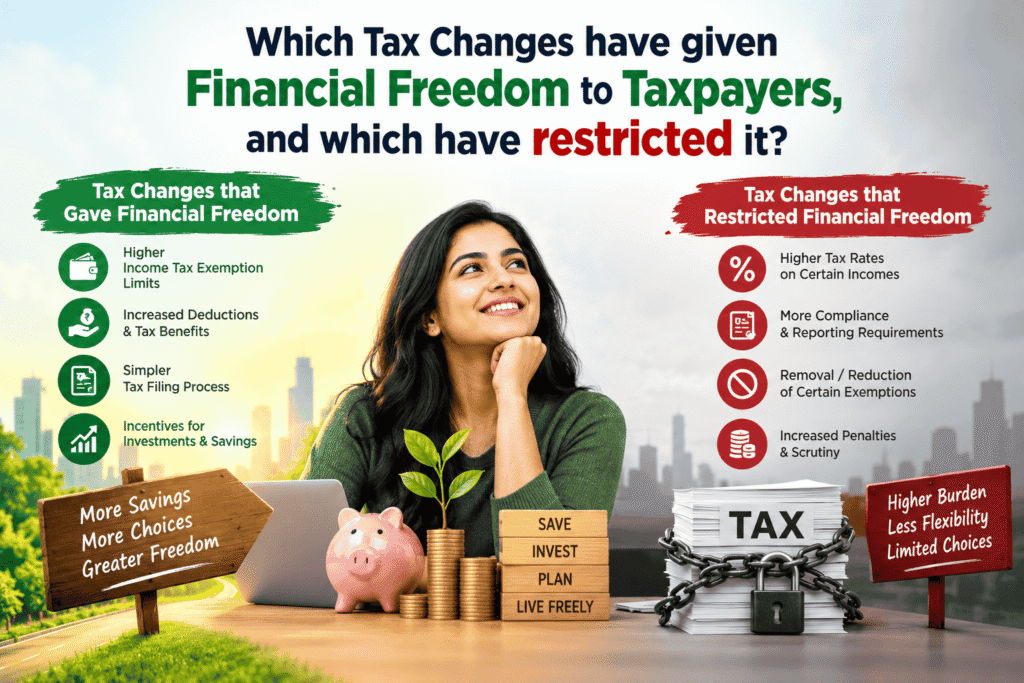
Which Tax Changes Have Given Financial Freedom to Taxpayers, and Which Have Restricted It?
Every Budget and every GST Council meeting changes something. Some changes put more money in your hands and give you more choice. Others add conditions, reduce benefits or tighten compliance. For a business owner or an individual taxpayer, the real question is simple: which of these changes help me, and which limit me?
In this guide, our chartered accountants break down the major tax changes of recent years across income tax, capital gains and GST, and explain how to plan around both the opportunities and the restrictions.
Tax Changes That Gave Taxpayers More Freedom
1. Higher tax-free income under the new regime
The new tax regime now lets resident individuals with taxable income up to ₹12 lakh pay no tax on regular income, through an enhanced rebate. With the standard deduction, salaried taxpayers can go beyond that. For many middle-income families this is the single biggest cash-flow benefit in years.
2. Choice between two tax regimes
Taxpayers can compare the new regime (lower rates, fewer deductions) with the old regime (higher rates, deductions such as 80C, 80D and HRA) and pick what suits them. Choice itself is a form of financial freedom, because you can plan investments and expenses by what you need, not only by what saves tax.
3. GST rate rationalisation and simpler slabs
The GST structure has been simplified into fewer main rates, and rates on many everyday goods and services were reduced. This lowers costs for consumers and cuts classification disputes for businesses, which is good for pricing and cash flow.
4. A simpler Income-tax Act and longer filing windows
The Income-tax Act, 2025 replaced the 1961 law from 1 April 2026, with a shorter structure, plainer language and a single “Tax Year” concept instead of “Financial Year” and “Assessment Year”. Filing dates for certain non-audit returns were also extended, and the window to file an updated return was widened. This gives you more time and more room to correct genuine errors.
5. Lower TDS and TCS friction
Higher TDS thresholds on items like interest and rent, and reduced TCS rates on some foreign remittances such as education and medical spends, mean less money is blocked while you wait for a refund.
6. Faceless processes and decriminalisation of minor defaults
Faceless assessments and appeals, online portals and dispute-resolution schemes have reduced personal interface, delays and harassment. Several minor technical defaults are no longer treated as serious offences.
Tax Changes That Restricted Taxpayers
1. The new regime is the default, with fewer deductions
If you do nothing, you are taxed under the new regime. That regime gives up most deductions, including 80C, 80D and HRA. People with large home loans, insurance and investments may pay more if they do not compare both options carefully.
2. Capital gains rate changes and the end of indexation
Capital gains rates were revised in 2024, and the indexation benefit was removed for most assets. The calculation is simpler, but long-term holders of property and certain assets may see a higher effective tax cost. Special-rate income such as capital gains also does not benefit from the ₹12 lakh rebate.
3. Higher transaction taxes on derivatives
An increase in securities transaction tax on futures and options trading has raised costs for active traders, regardless of whether a trade makes a profit.
4. Tighter GST input tax credit and matching rules
Input tax credit now depends heavily on supplier compliance and matching with auto-drafted statements. A supplier’s default can block your credit, raise your cost and trigger notices, as explained in our guide on how to respond to a GST notice.
5. Payment-time conditions for MSME suppliers
Expenses owed to micro and small enterprises are allowed as a deduction only if paid within the time limits in the law. Late payments to such suppliers can increase a business’s taxable income.
6. More reporting, higher TCS on some spends and stricter data matching
The department now compares your return against data from banks, employers, brokers and registrars. Mismatches create notices, and TCS applies to certain high-value overseas and other transactions. Convenience has come with more visibility.
Quick Comparison Table
| Area | What gave freedom | What restricted it |
|---|---|---|
| Income tax | Tax-free income up to ₹12 lakh (new regime), choice of regime | New regime is default, fewer deductions |
| Capital gains | Simpler calculation | Revised rates, indexation removed, no rebate on special-rate gains |
| GST | Fewer slabs, lower rates on many items | Strict ITC matching, stronger notices |
| Compliance | Simpler Act, longer deadlines, faceless processes | More data matching and reporting |
| Trading and spends | Lower TCS on selected remittances | Higher STT on derivatives, TCS on some spends |
How to Plan Around These Changes
- Compare both regimes every year. Your best option can change as your salary, loans and investments change.
- Plan capital gains before you sell. The holding period, asset type and timing of a sale can change your tax by a large amount.
- Reconcile GST every month. Match your purchase register with auto-drafted statements and follow up on supplier defaults early.
- Pay MSME suppliers on time. This protects both relationships and deductions.
- Check your annual information statement. Fix mismatches before you file, not after you get a notice.
- Keep digital records. Bills, contracts, bank statements and investment proofs should be easy to find.
- Review mid-year, not only in March. A mid-year review gives you time to act on deductions, advance tax and investments.
Remember: a tax change is a “freedom” only if you use it, and a “restriction” only if you ignore it. The same rule can save one taxpayer lakhs and cost another, depending on how they plan.
At G Kedia & Associates, our partners advise individuals, professionals and businesses on income tax, GST, audits and tax planning. See our services or meet our partners.
Frequently Asked Questions
Is income up to ₹12 lakh really tax-free in India?
Under the new tax regime, a rebate means resident individuals with taxable income up to ₹12 lakh pay no tax on regular income. Salaried taxpayers also get a standard deduction, which takes the effective limit higher. The rebate does not apply to special-rate income such as certain capital gains.
Which tax regime is better, old or new?
It depends on your income and deductions. The new regime has lower slab rates and fewer deductions, while the old regime allows deductions such as 80C, 80D and HRA. Compare both every year before choosing.
What changed in capital gains tax?
The tax rates on many capital gains were revised in 2024, and the indexation benefit was removed for most assets. This simplified the calculation but increased the tax cost for some long-term property holders.
Did GST rate changes help consumers and businesses?
The GST rate rationalisation moved most goods and services into fewer slabs and reduced rates on many everyday items, which lowers cost and simplifies billing. Businesses should still check classification, invoicing and input tax credit rules carefully.
Can I correct an income tax return after filing it?
Yes. You can file a revised return, or an updated return within the extended window allowed by law, though additional tax may apply. Speak to your CA before filing.
Want to know which changes help you the most?
Our team will compare both regimes, review your investments and GST position, and build a tax plan that fits your goals.
Book a Tax Planning Consultation